
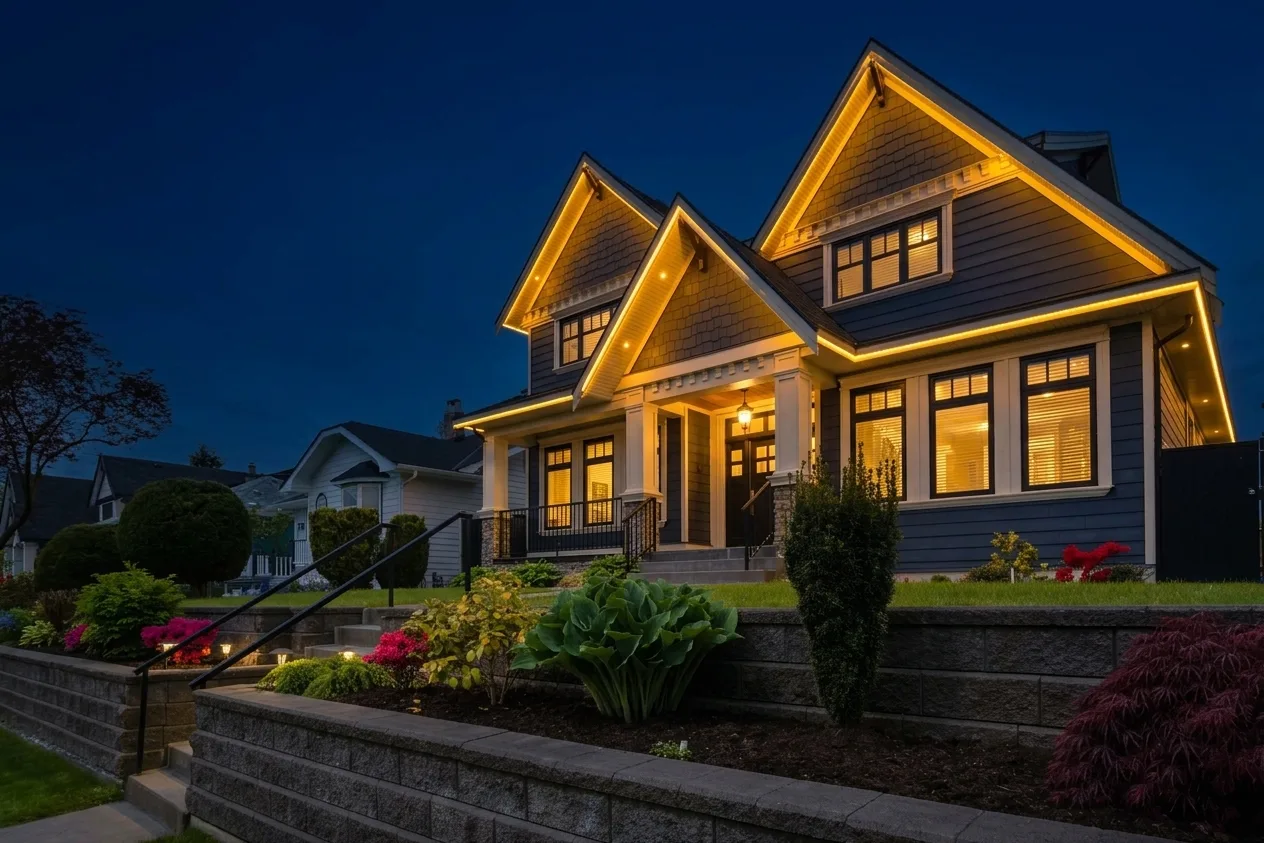
You want your home to stand out after dark, but you keep running into the same question: should you go with soffit lighting tucked along the eaves, or roofline lights that trace the outer edge of your roof? The two systems look similar in photos, but they work differently, cost differently, and suit different homes. Getting the choice wrong means living with the wrong look for years, so it pays to understand what each option actually does before you commit.
- What Is Soffit Lighting?
- What Are Roofline Lights?
- Key Differences Side by Side
- Which Homes Benefit Most from Each System
- What Affects the Cost and Installation
- Making Your Final Decision
- Frequently Asked Questions
What Is Soffit Lighting?
Soffit lighting refers to fixtures mounted in, or directed from, the horizontal underside of your roof overhang, also called the soffit. The lights shine downward and outward, washing your exterior walls and landscaping in a warm, even glow. Because the fixtures sit inside the overhang, they stay protected from direct rain and harsh wind, which extends their lifespan considerably.
Most modern soffit lighting systems use low-voltage LEDs. That keeps energy costs manageable and lets you run the lights for hours every night without watching your electricity bill climb. Many homeowners pair them with accent lighting Naperville installations along pathways or in garden beds to create a layered look that reads as intentional rather than afterthought.
The hidden placement is the defining feature. Guests notice the light washing your facade rather than the fixtures themselves. That clean, understated appearance is exactly why soffit lighting has become popular in neighborhoods across Naperville where HOAs or architectural guidelines favor tidy exteriors.
What Are Roofline Lights?
Roofline lights mount along the outer edge of your roofline, either clipped to the fascia board or installed just below the peak. Unlike soffit lighting, the fixtures themselves are visible from the street. That visibility is a feature, not a flaw. Roofline lights are designed to trace the architectural outline of your home, making the silhouette pop against the night sky.
Permanent roofline systems, sometimes called trim lights or pixel lights, are programmable and color-changing. One set of fixtures can display warm white for everyday curb appeal, shift to red and green for December, and then cycle through team colors on game nights. If that kind of flexibility appeals to you, our permanent holiday lights Naperville page explains how the system works in detail. You can also browse our trim lighting service for a closer look at fixture options.
The tradeoff is visibility. If you prefer a minimalist exterior, seeing the track or channel along your roofline year-round may feel like a compromise. For homeowners who love seasonal displays and colorful variety, though, that visible channel is a small price for enormous flexibility.
Key Differences Side by Side
The easiest way to compare the two systems is to look at a few practical dimensions: placement, visibility, flexibility, and purpose.
- Placement: Soffit lighting sits inside the overhang and stays hidden. Roofline lights mount along the outer fascia and are visible from the street.
- Light direction: Soffit fixtures project downward onto walls and landscaping. Roofline lights define the outer edge and silhouette of the home.
- Color options: Most soffit systems offer warm or cool white. Most permanent roofline systems are fully programmable with millions of colors.
- Seasonal use: Soffit lighting is a year-round ambient system. Roofline lights double as Christmas lights and holiday displays.
- Curb appeal style: Soffits produce a subtle, architectural glow. Roofline lights make a bolder, more festive statement.
Neither system is objectively better. They solve different problems for different homeowners, and in many cases the right answer is to use both together. Architectural lighting Naperville projects frequently combine soffit downlighting with a roofline channel system to create full exterior coverage.
Which Homes Benefit Most from Each System
Soffit lighting works best on homes with substantial overhangs that provide a natural mounting surface and shelter for the fixtures. Ranch-style homes, craftsman bungalows, and newer construction with wide eaves are ideal candidates. If your home has a flat or very shallow pitch with minimal overhang, there may not be enough soffit to work with, and roofline lighting becomes the more practical path.
Roofline lights shine on homes where the owner wants seasonal flexibility without climbing a ladder every November. Because the channel is permanently installed, switching from everyday white to a holiday color palette takes minutes through an app. Our app controlled lights Naperville service can walk you through how the scheduling and color control works on a phone or tablet.
Homes with complex rooflines, multiple gable peaks, or decorative trim details tend to look especially good with roofline systems because the lights follow every contour. Soffit lighting, by contrast, rewards homes with long horizontal overhangs where the downward wash can cover the full facade evenly. Pairing soffit lighting with landscape lighting in the front yard ties the whole exterior together into one cohesive design.
What Affects the Cost and Installation
Both systems require professional installation to look polished and to meet electrical code. DIY soffit lighting often results in uneven fixture spacing, visible wiring, or fixtures that are not weatherproofed correctly. A professional crew measures the soffit run, spaces fixtures evenly, and routes low-voltage wire through the overhang so nothing is exposed.
Roofline systems involve running a channel or track along the fascia and connecting it to a controller box. The upfront cost is generally higher than a basic soffit installation because of the programmable hardware involved. However, you eliminate the annual cost of hanging and removing temporary holiday lights, which adds up quickly over a few seasons.
For soffit lighting specifically, the total price depends on linear footage, fixture count, and whether you add a dimmer or timer. Homes in Naperville range widely in size, so a precise quote requires a site visit. The best way to avoid budget surprises is to get an itemized estimate before any work begins. Custom house lights packages let us tailor the scope to what you actually need rather than selling you a fixed bundle that may not fit your home.
Making Your Final Decision
Start by asking two questions. First, do you want the fixtures to be visible or hidden? If hidden, soffit lighting is your answer. If visible is acceptable or even desirable, roofline lights open up far more color and programming options. Second, how important are seasonal displays to your household? If you love decorating for the holidays and want a no-ladder solution, permanent roofline lights pay for themselves in convenience within a few years.
If you are still undecided, consider the architecture of your home. Pull up a daytime photo and look at the roofline versus the overhang. Whichever element draws your eye is usually the one worth lighting. Many Naperville homeowners end up layering both systems, using soffit lighting along the eaves and a roofline channel overhead, because the two complement each other without competing.
Whatever direction you choose, professional design and installation make a measurable difference in the final result. Poorly spaced fixtures, incorrect beam angles, or mismatched color temperatures can undermine even the best equipment. Getting the details right from the start means years of enjoyment rather than years of wishing you had done it differently.
Ready to light up your home the right way? Luna Rae Lighting serves Naperville homeowners with professional soffit lighting, roofline systems, and full exterior lighting design. Contact us today for a free consultation and on-site estimate. We will help you figure out exactly which system, or combination of systems, fits your home, your style, and your budget. Reach out through our soffit lighting page or give us a call to get started.
Frequently Asked Questions
How long does soffit lighting installation typically take?
Most single-family homes are completed in a single day, depending on the linear footage and the complexity of the wire routing. Larger homes or those with multiple roof levels may take two days. Your installer can give you a more precise timeline after measuring the site.
Can soffit lighting be used for holiday displays?
Yes, though with limitations. Standard soffit lighting is single-color and not programmable, so it adds ambiance but cannot flash or change colors the way a permanent roofline system can. If holiday displays are a priority, a roofline system or a combination of both gives you much more flexibility for seasonal looks.
Do soffit lights work on homes without overhangs?
No, homes without meaningful overhangs do not have a mounting surface or protective cavity for soffit fixtures. In those cases, roofline lighting mounted along the fascia board is a better fit. An on-site assessment will confirm what your specific roofline can support.
Are permanent roofline lights visible during the day?
Yes, the channel or track that holds the fixtures is visible during daylight hours. Most systems use a low-profile channel in a color matched to your fascia, which minimizes the daytime appearance. Many homeowners find the channel nearly unnoticeable after a few weeks, but it is worth seeing an example before committing.
How much energy do soffit lighting systems use?
LED soffit fixtures typically draw between 3 and 8 watts each, making them very energy efficient. A home with 20 fixtures running 6 hours a night uses roughly the same electricity as one or two standard incandescent bulbs. Exact usage depends on fixture count, wattage, and how many hours per night the system runs.
Can I control soffit lighting with a smartphone?
Yes, many modern soffit lighting systems are compatible with smart timers and app-based controllers that let you set schedules, adjust brightness, and turn lights on or off remotely. If smart control is important to you, tell your installer upfront so they can specify compatible hardware from the start.